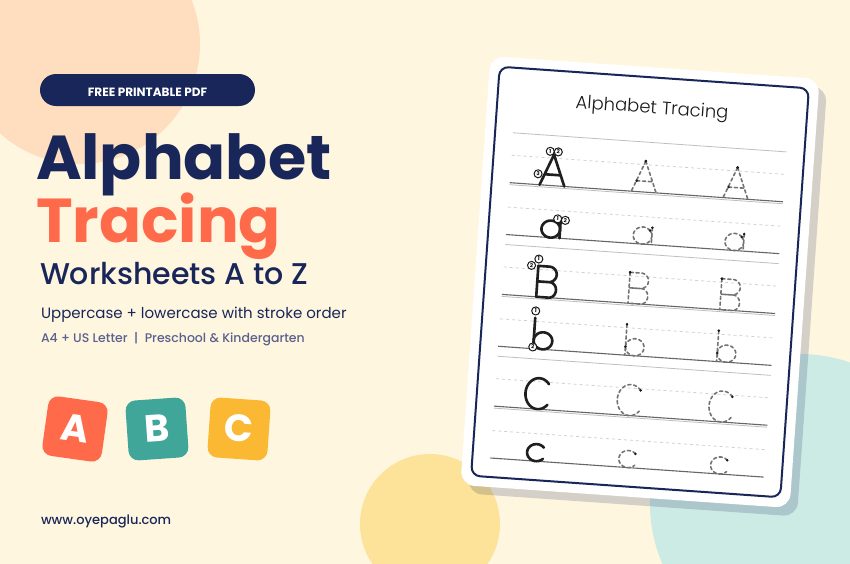
Most alphabet tracing sheets give a child a letter and a dashed outline, and that’s it. These alphabet tracing worksheets add the part that usually goes missing: where to start and which way to go. Every letter has small stroke numbers, so a child can see that capital E begins at the top, goes down, and then gets three lines added.
The letters are written on proper three-line handwriting guides (top line, dotted middle line, base line). It’s a small detail, but it’s what teaches a child that “b” is tall and “a” is short. All pages are in both US Letter and A4, in light grey to save ink.
Free Alphabet Tracing Worksheets A to Z (PDF)
Letter-by-letter pages: capital and small together
Each page covers three letters, with a capital row and a small-letter row for each. Start with the letters in your child’s name and then go in order.
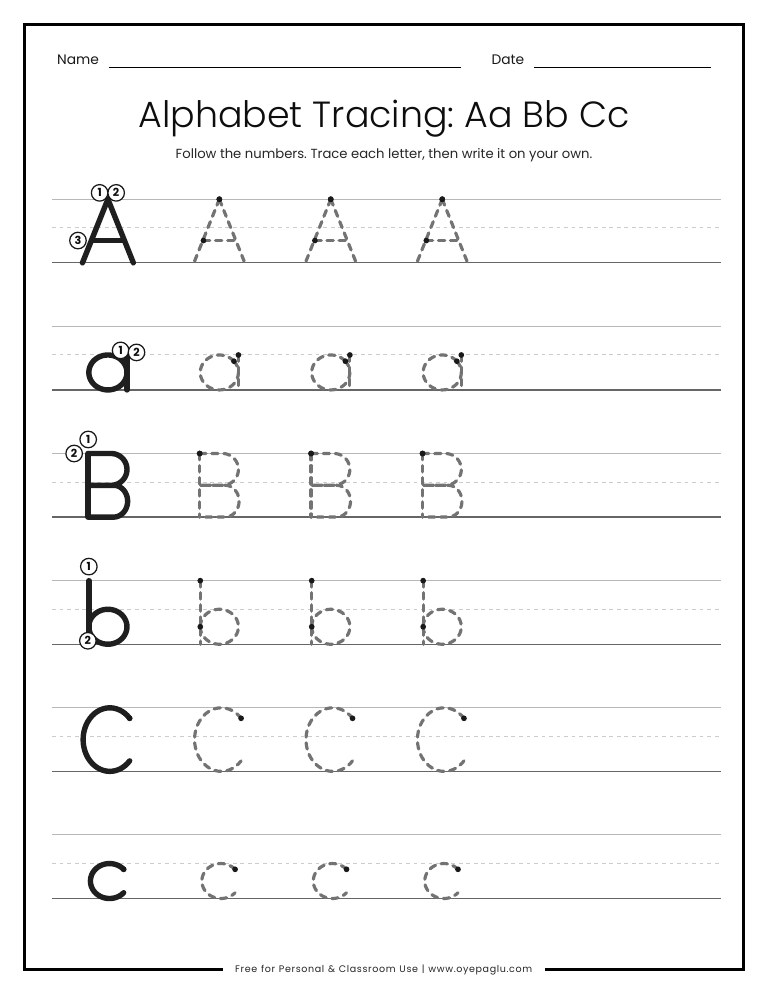
The first line shows the letter with its stroke numbers, then three dashed copies and two blank spaces to write alone. Each capital letter has its own set of lines, and so does each small letter (A, B, C).
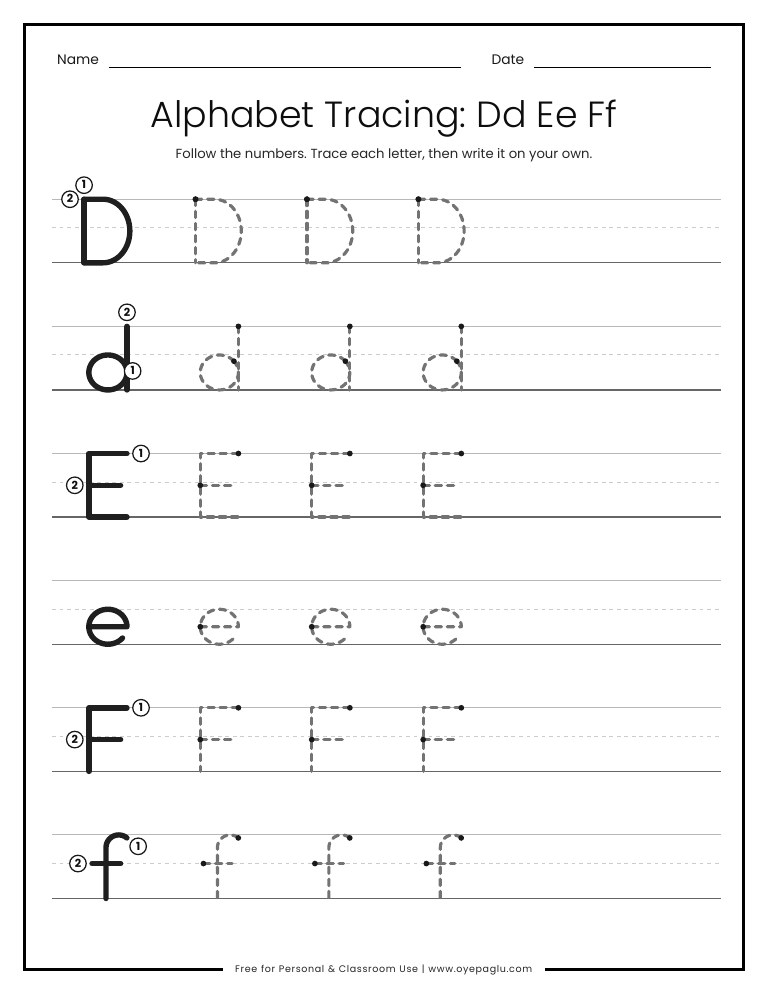
The first line shows the letter with its stroke numbers, then three dashed copies and two blank spaces to write alone. Each capital letter has its own set of lines, and so does each small letter (D, E, F).
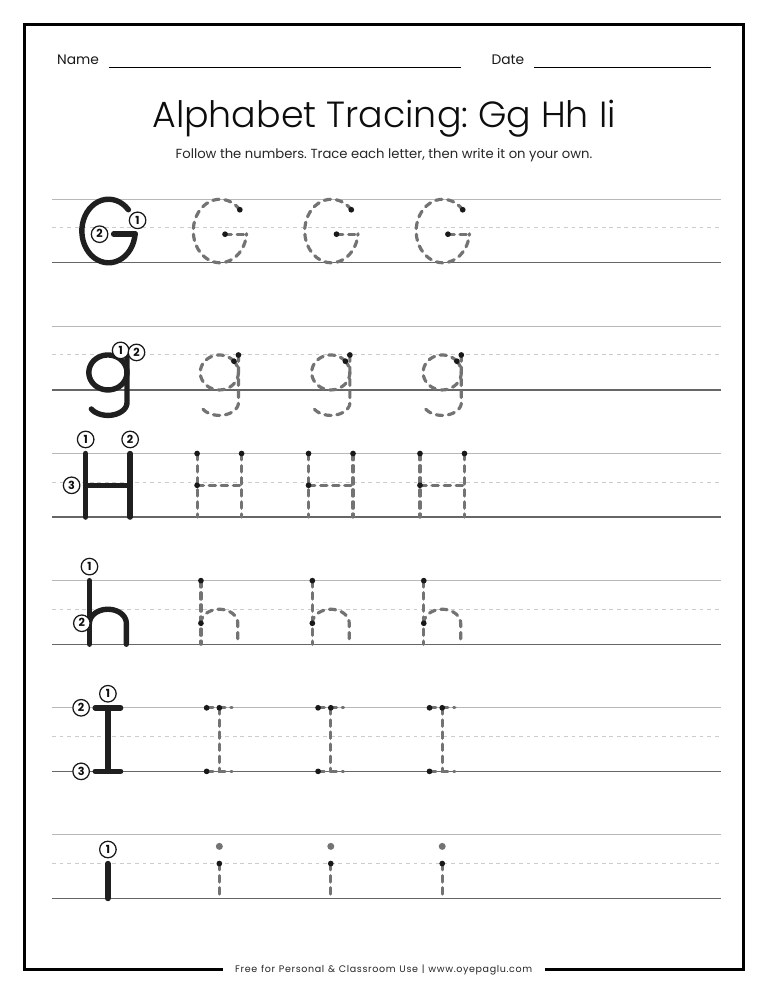
The first line shows the letter with its stroke numbers, then three dashed copies and two blank spaces to write alone. Each capital letter has its own set of lines, and so does each small letter (G, H, I).
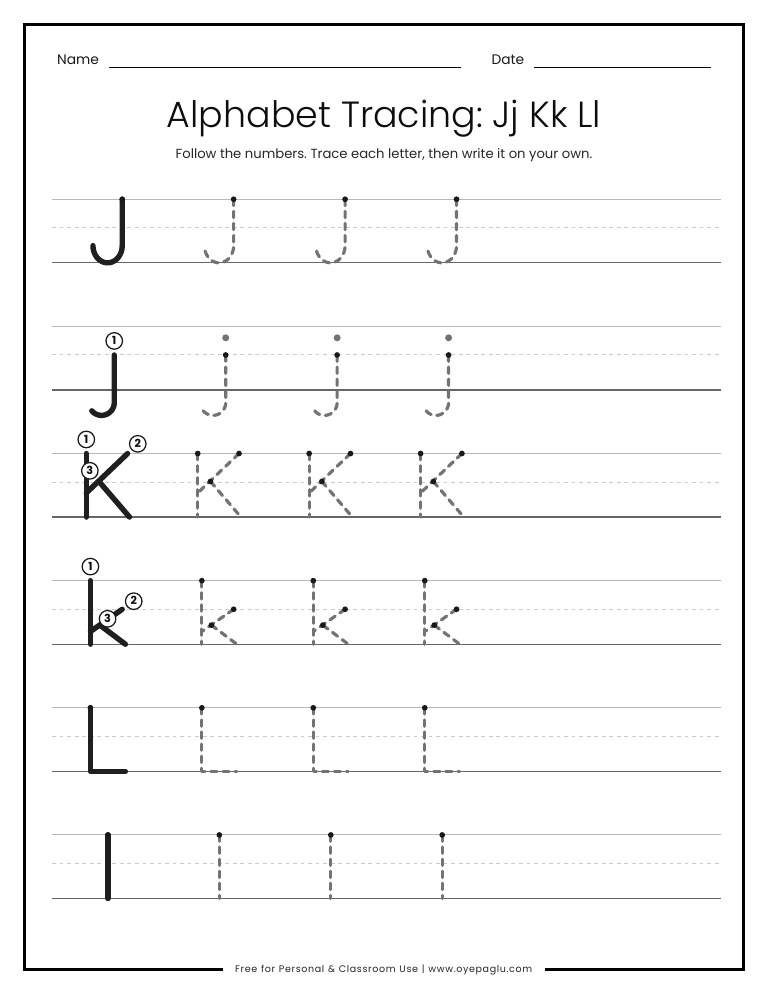
The first line shows the letter with its stroke numbers, then three dashed copies and two blank spaces to write alone. Each capital letter has its own set of lines, and so does each small letter (J, K, L).
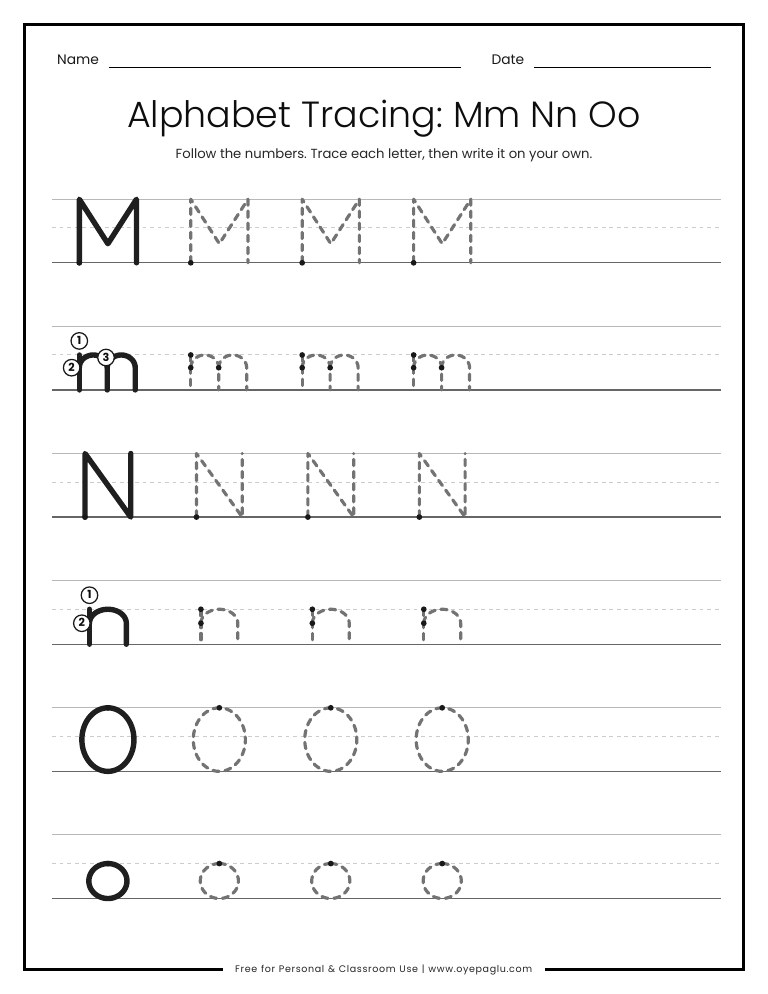
The first line shows the letter with its stroke numbers, then three dashed copies and two blank spaces to write alone. Each capital letter has its own set of lines, and so does each small letter (M, N, O).
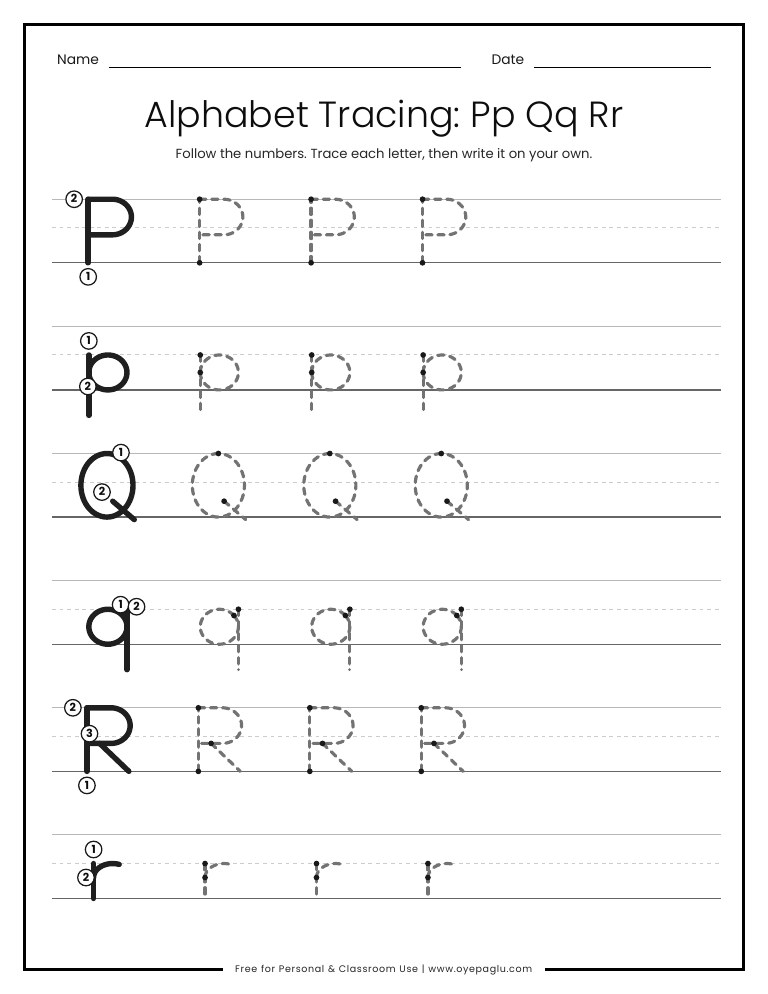
The first line shows the letter with its stroke numbers, then three dashed copies and two blank spaces to write alone. Each capital letter has its own set of lines, and so does each small letter (P, Q, R).
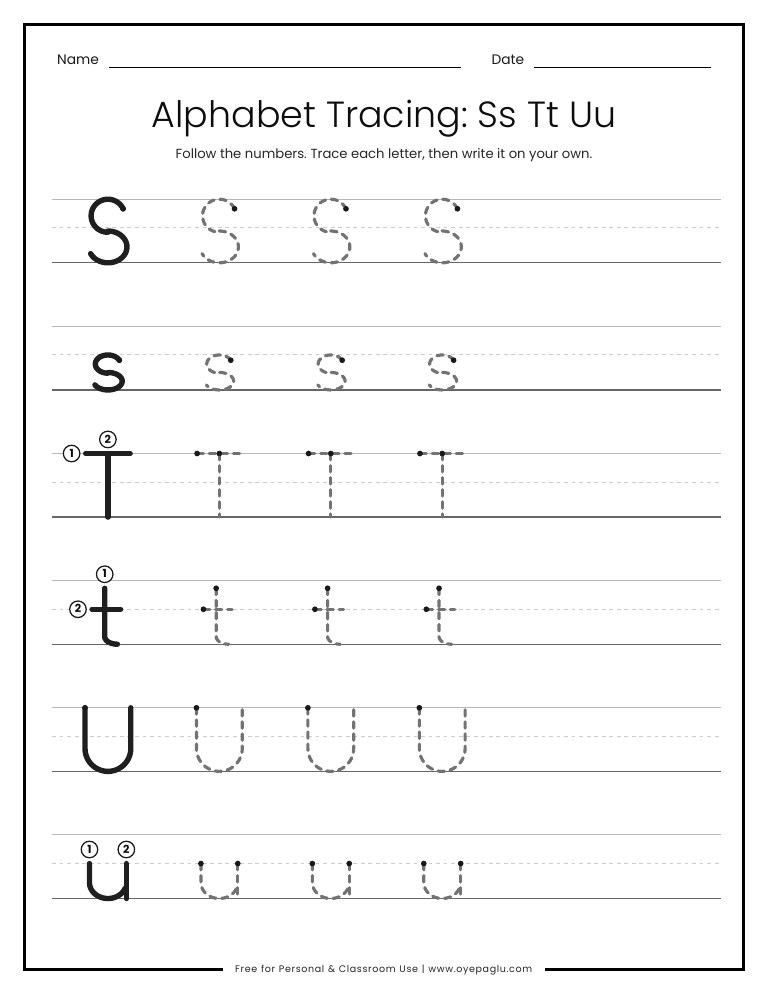
The first line shows the letter with its stroke numbers, then three dashed copies and two blank spaces to write alone. Each capital letter has its own set of lines, and so does each small letter (S, T, U).
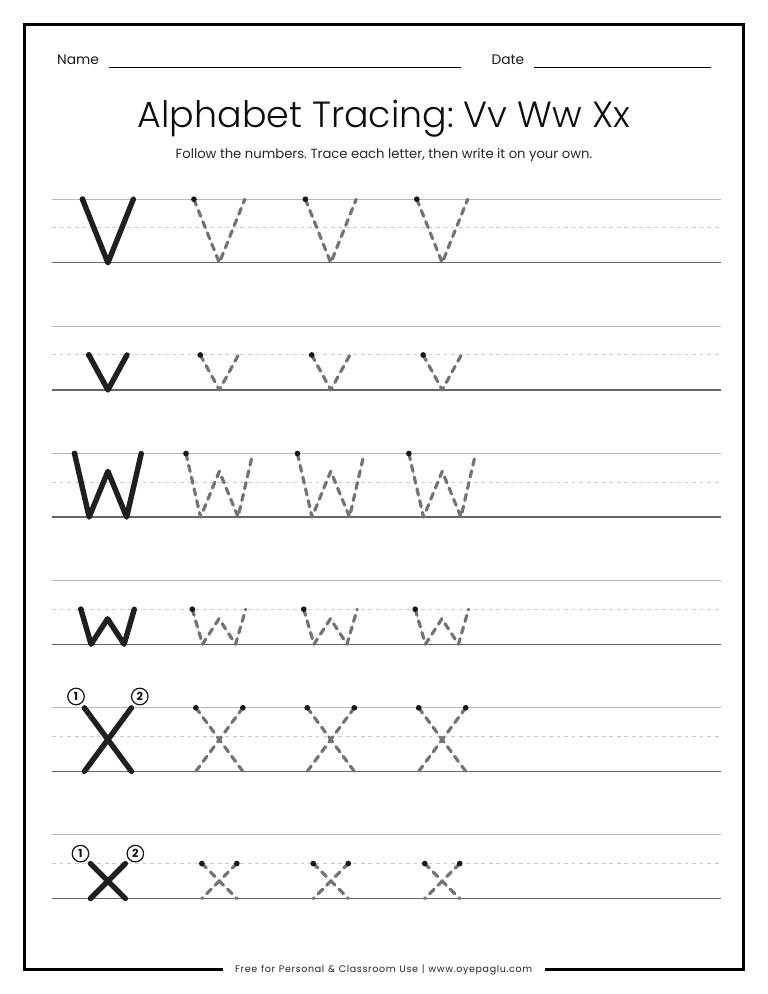
The first line shows the letter with its stroke numbers, then three dashed copies and two blank spaces to write alone. Each capital letter has its own set of lines, and so does each small letter (V, W, X).
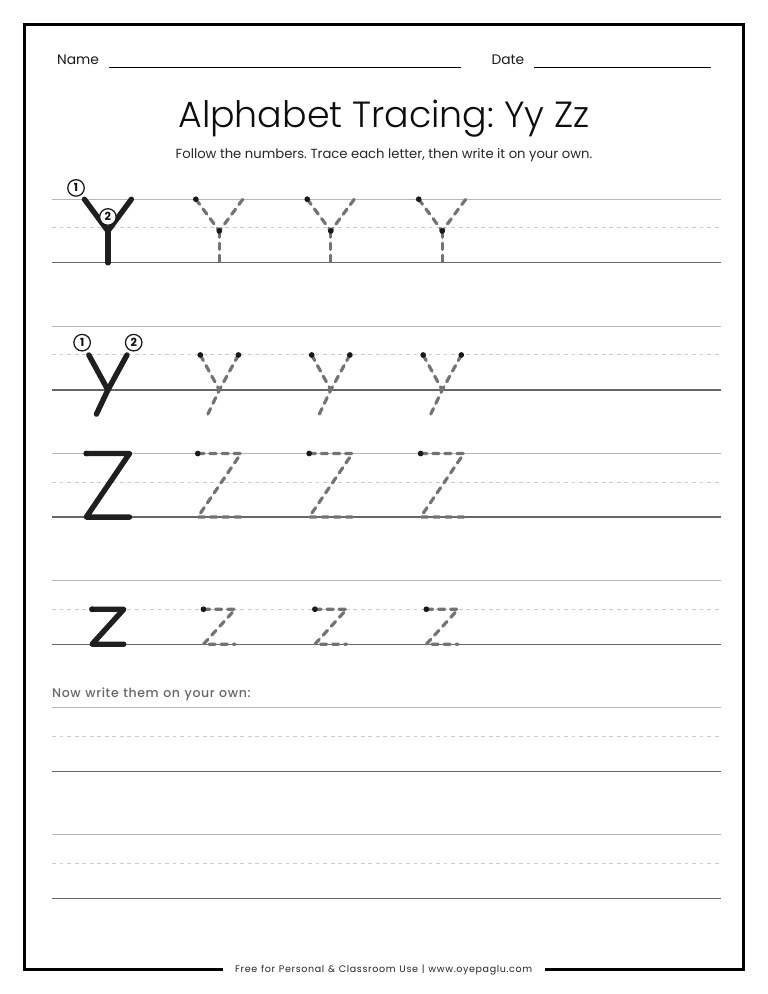
The first line shows the letter with its stroke numbers, then three dashed copies and two blank spaces to write alone. Each capital letter has its own set of lines, and so does each small letter (Y, Z).
Whole alphabet on one page
Once your child knows the strokes, these pages are good for a quick revision or a daily warm-up.
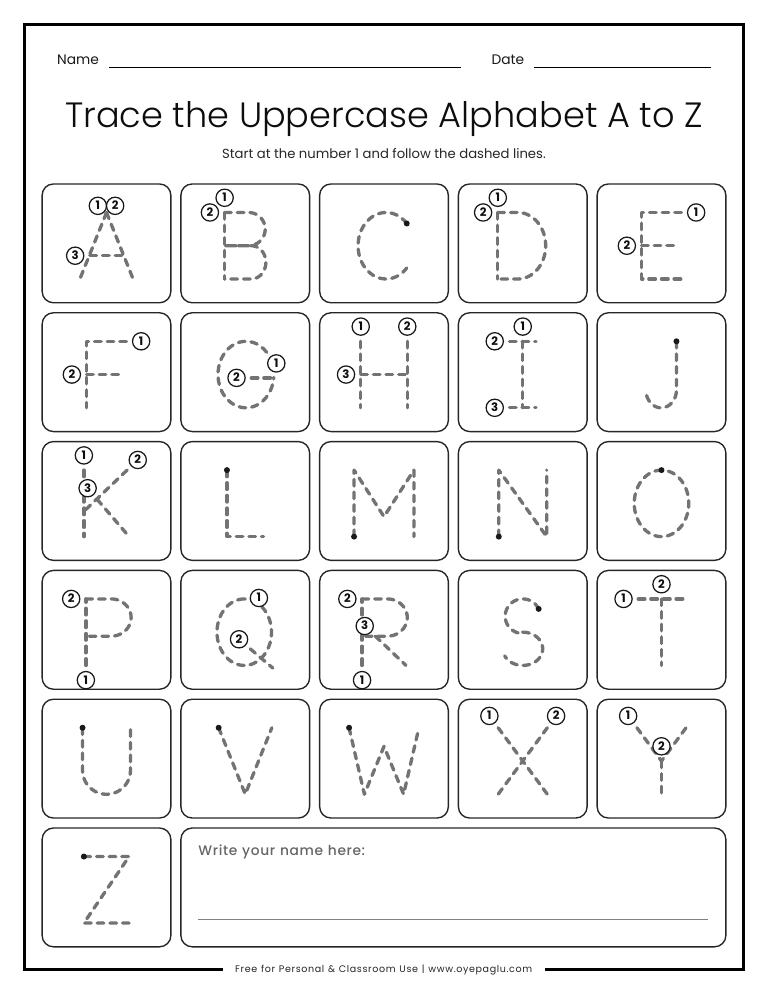
All 26 capital letters on one page, each with numbered start points. Good for a quick warm-up or a full A to Z revision.
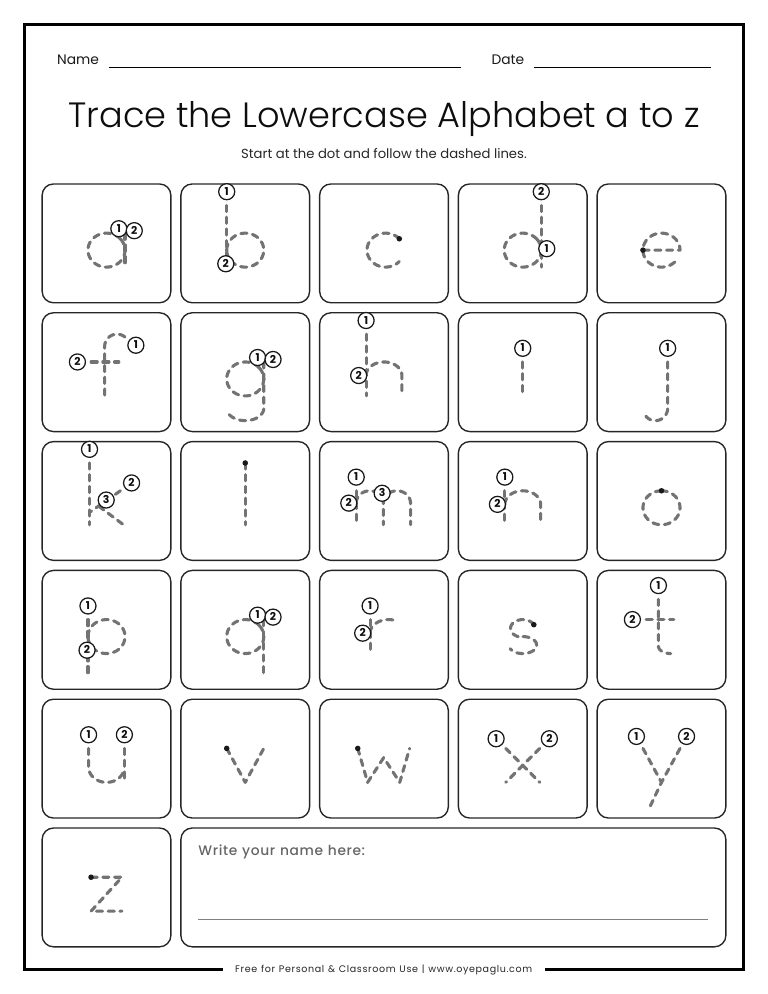
All 26 small letters on one page with start dots. The tall, short and tail letters (like b, a and g) are sized correctly.
Letter games to go with the tracing
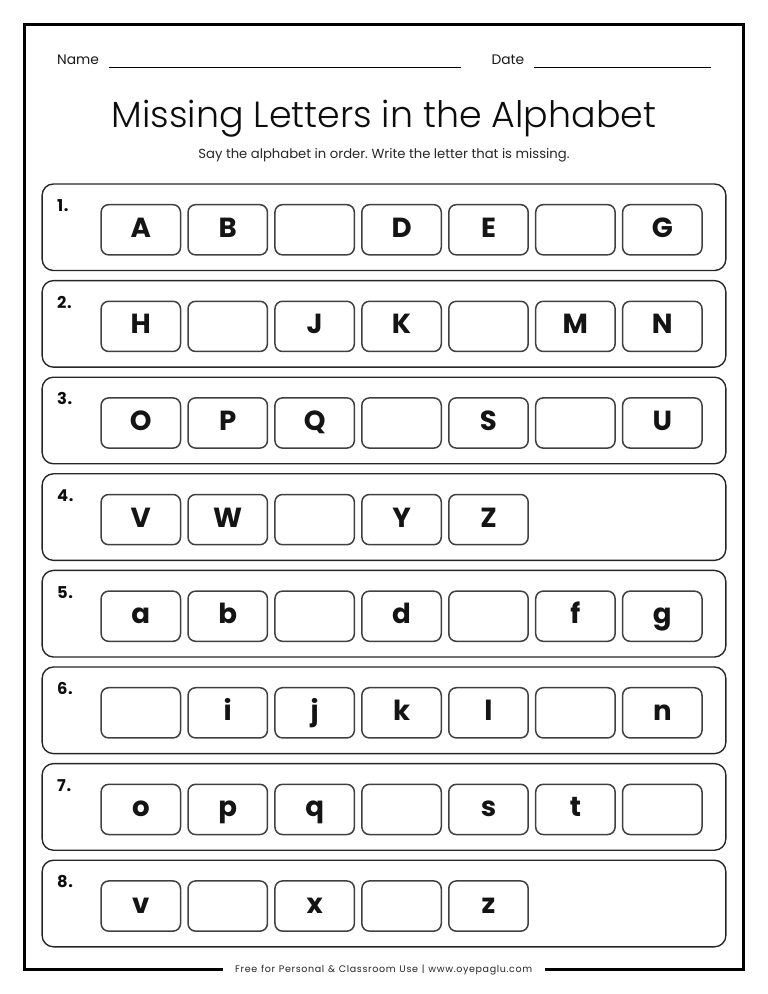
Four rows of capitals and four rows of small letters, each with one or two gaps. Kids say the alphabet in order and write the missing letter.
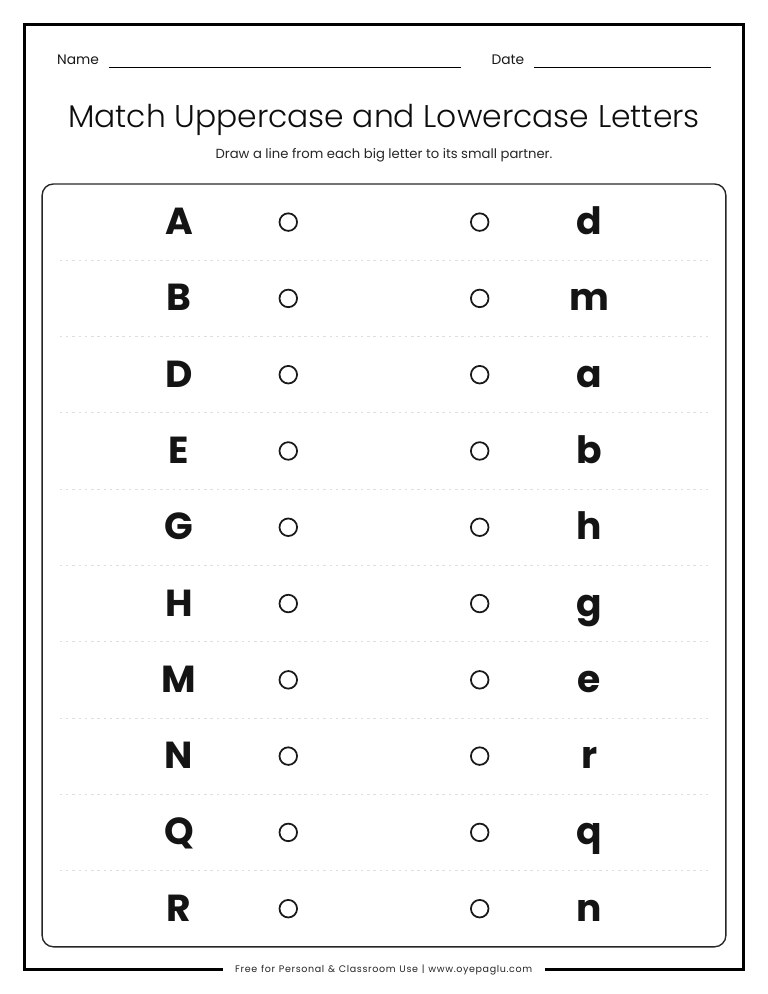
Ten capital letters on the left, ten small partners on the right in a mixed-up order. Kids draw a line to link each pair.
How the stroke numbers work
A solid letter with numbers is the model. A number in a small circle shows where a line begins, and the order of the numbers is the order of the lines. Letters with only one line (like C, O, S) have just a dot to show the start. On the dashed copies, a dot marks the start so your child can begin in the right place without checking the model every time.
What the three handwriting lines mean
- Top line: where capital letters and tall small letters (b, d, f, h, k, l, t) reach.
- Dotted middle line: where short letters (a, c, e, m, n, o) stop.
- Base line: where every letter sits. Letters like g, j, p, q and y drop a tail below it.
Letters kids mix up
Almost every child flips b and d, or p and q, at some point. It’s normal at this age. A trick that works: b starts with the line (a “bat”) and then the ball, d starts with the ball and then the line. On the b and d pages, say “line first” or “ball first” before each letter.
In what order should I teach the letters?
Alphabetical order is fine for the pages above, but if your child is just starting, begin with letters made from straight lines (L, T, I, H, E, F), move on to curves (C, O, S, U), then the diagonals (A, V, W, X, Y, Z, K) last. Diagonals are the hardest for small hands.
Frequently asked questions
What age are these for?
Usually ages 3 to 6. Younger kids can trace just the big model letter with a finger or a chunky crayon first.
Capital or small letters first?
Capitals are easier because they use simple lines and curves, so most kids start there. But since most reading is in small letters, move on to those soon.
Which size should I download?
US Letter if you’re in the US or Canada, A4 almost everywhere else. Print at 100% / actual size, not “fit to page”, so the guide lines stay the right height.
Are they free to print?
Yes, for home and classroom use. Please don’t sell or re-host the PDFs.