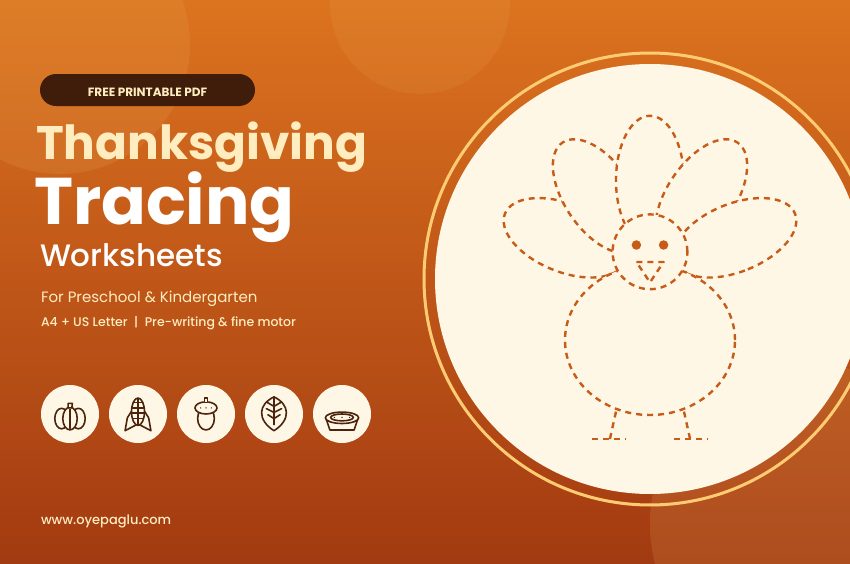
Before a child can write the letter “a” or “b”, the hand has to learn a handful of simple movements: straight lines, curves, circles and loops. These Thanksgiving tracing worksheets practise exactly those, using a turkey, corn, pumpkins, acorns and pie instead of plain lines. Your child follows the turkey across the page, and the practice happens without anyone calling it practice.
The set moves in small steps, from lines to patterns, shapes, pictures, words and finally a sentence. All pages are in US Letter and A4, in light dashed lines to save ink.
Free Thanksgiving Tracing Worksheets (PDF)
Step 1: Lines and patterns
Start here if your child is new to tracing or holds the pencil in a fist. These three pages build the basic strokes.
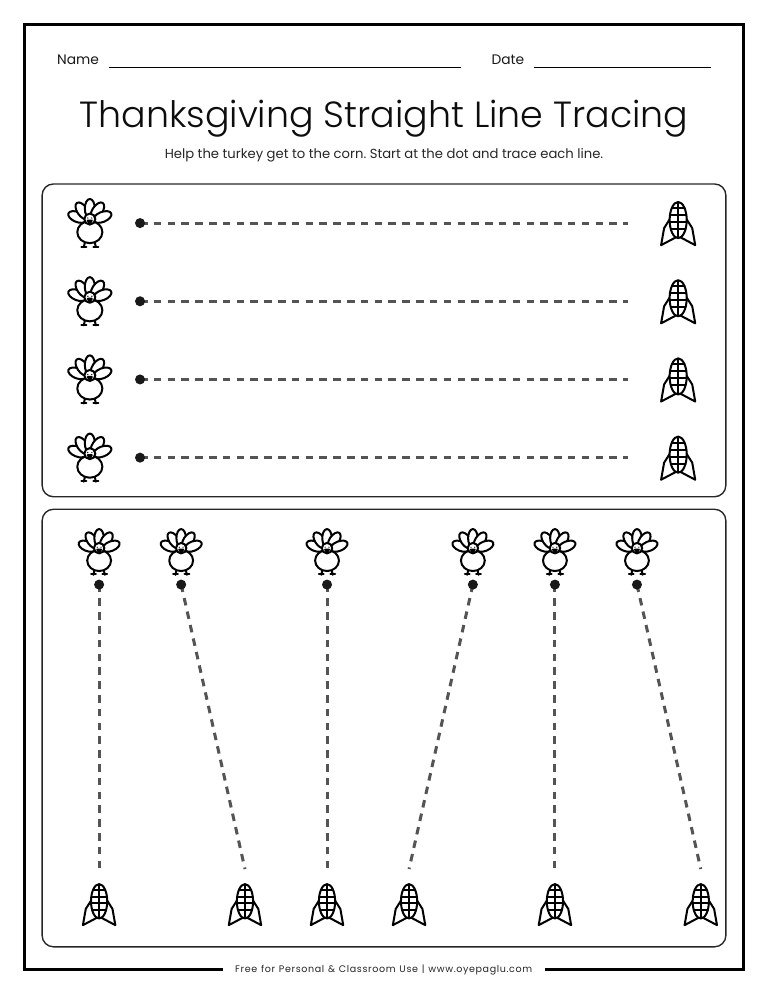
Four long lines from left to right, then six lines that go down and slant both ways. The turkey is the start, the corn is the finish.
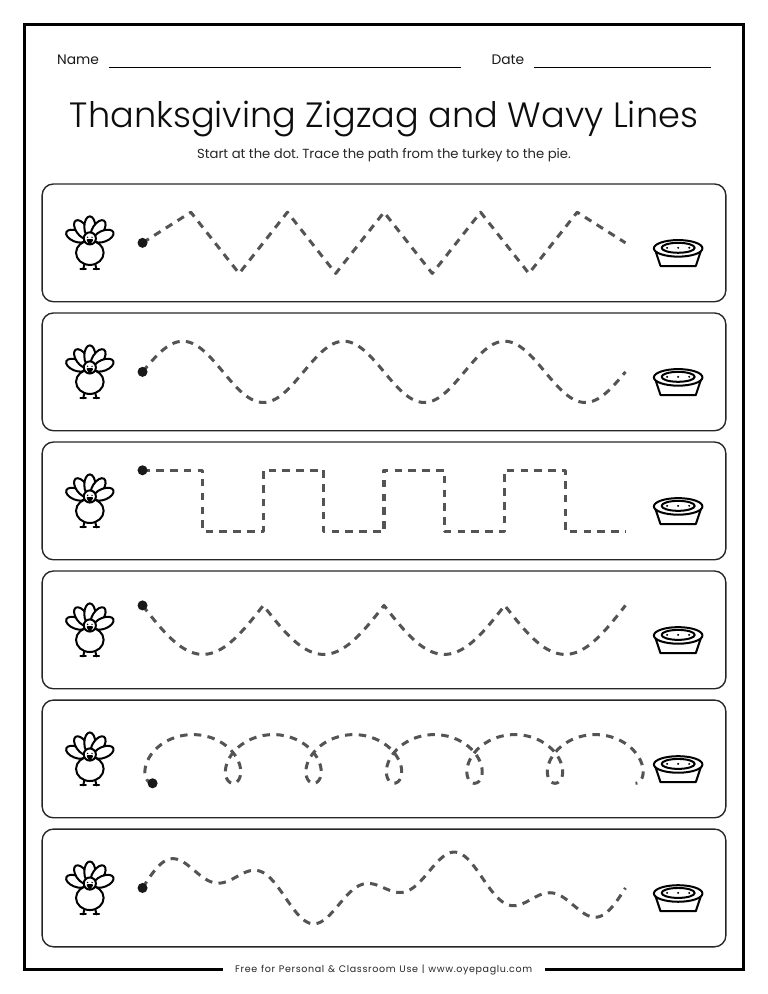
Six paths from the turkey to a pie: zigzag, wave, steps, hills, loops and a bumpy line. Each one needs a different hand movement.
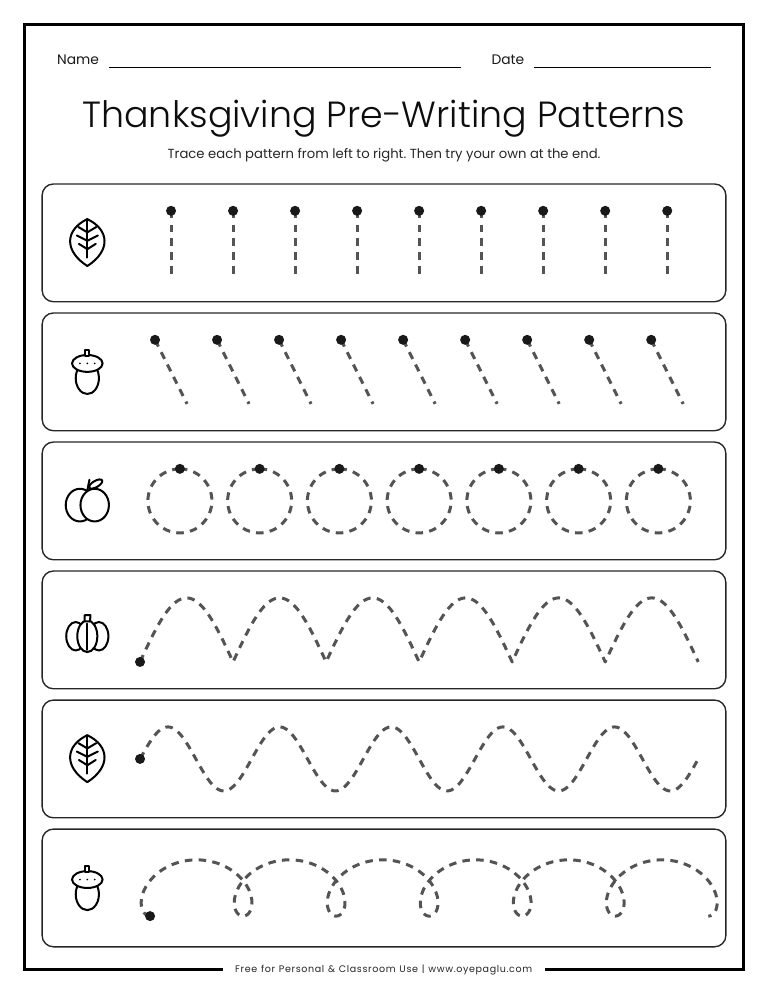
Rows of repeating strokes: straight lines, slants, circles, arches, waves and loops. These are the same strokes that later become letters.
Step 2: Shapes, pictures and the turkey
Closed shapes are harder than lines because the pencil has to come back to where it started. The big turkey page is a nice one to finish with crayons.
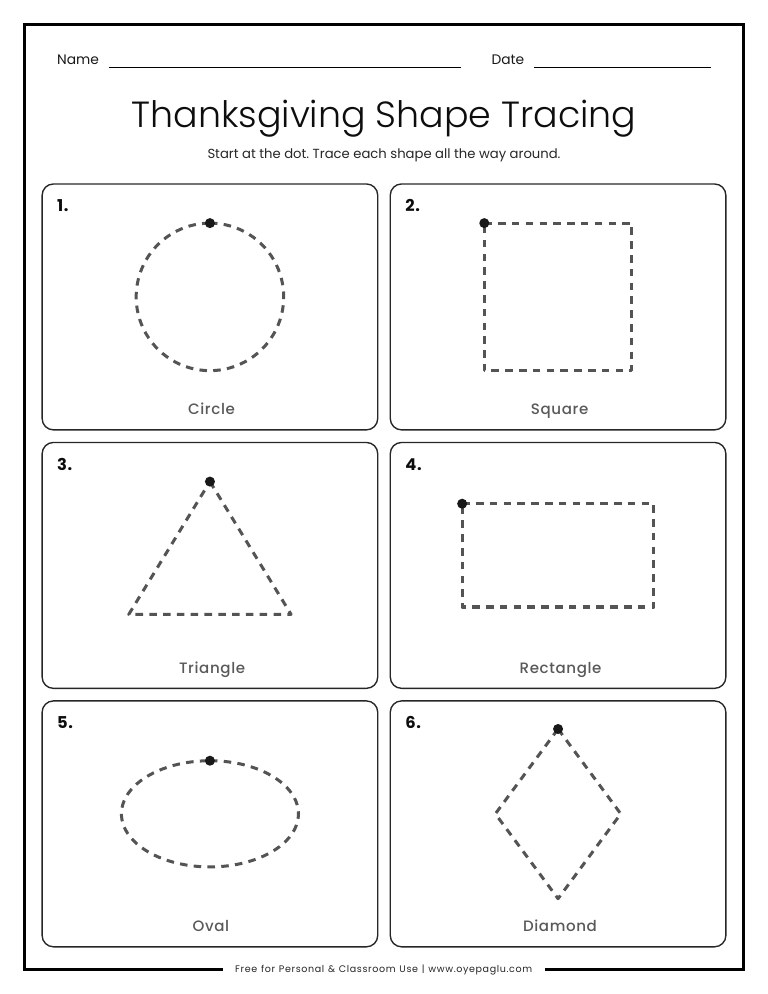
Six big shapes to trace: circle, square, triangle, rectangle, oval and diamond, each with a start dot.
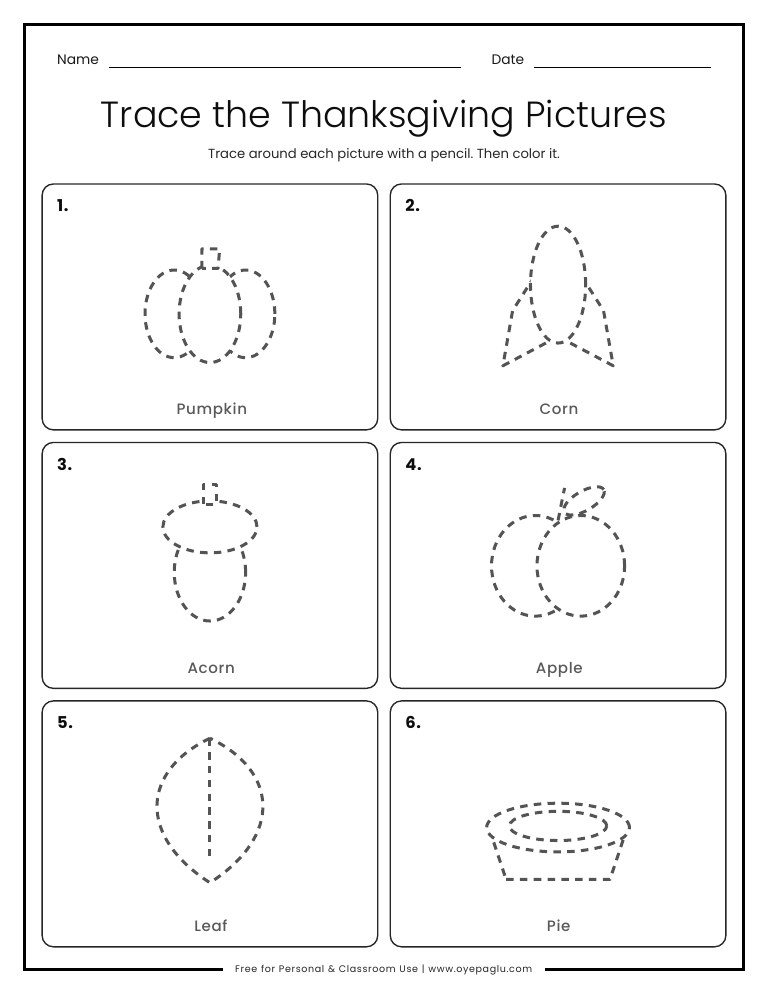
Dashed outlines of a pumpkin, corn, acorn, apple, leaf and pie. Trace, then color.
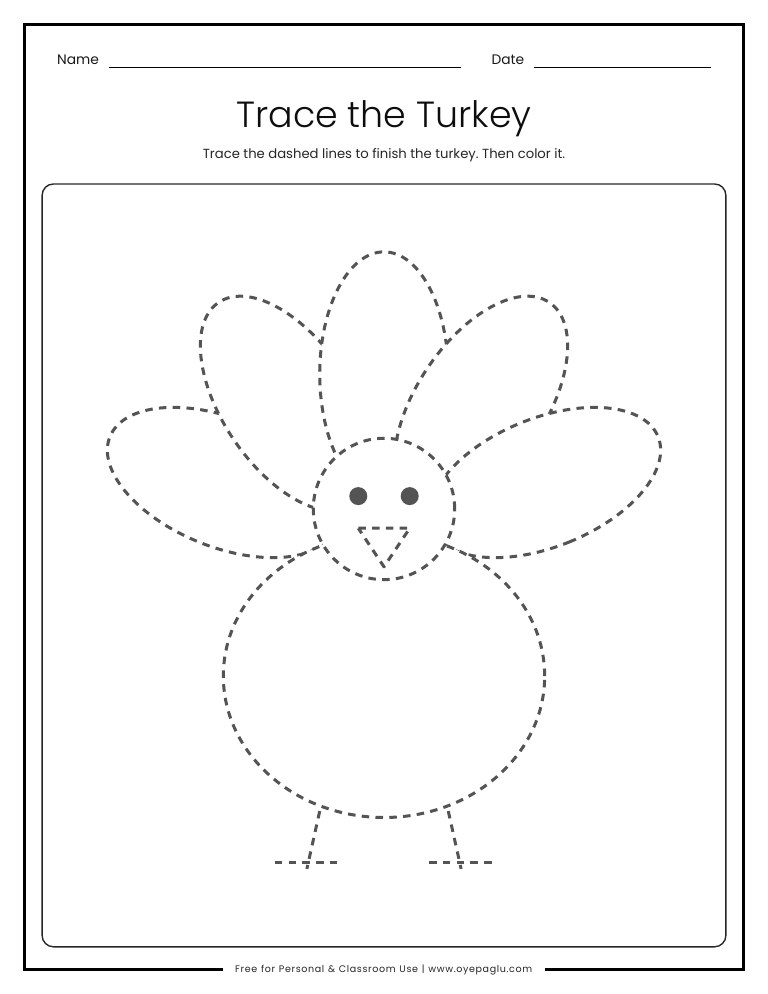
One big turkey, drawn in dashed lines, to trace and then color in. Big enough for a whole-hand grip.
Step 3: Words and a sentence
For kids who already know some capital letters. The words are the ones you’ll actually hear around the table.
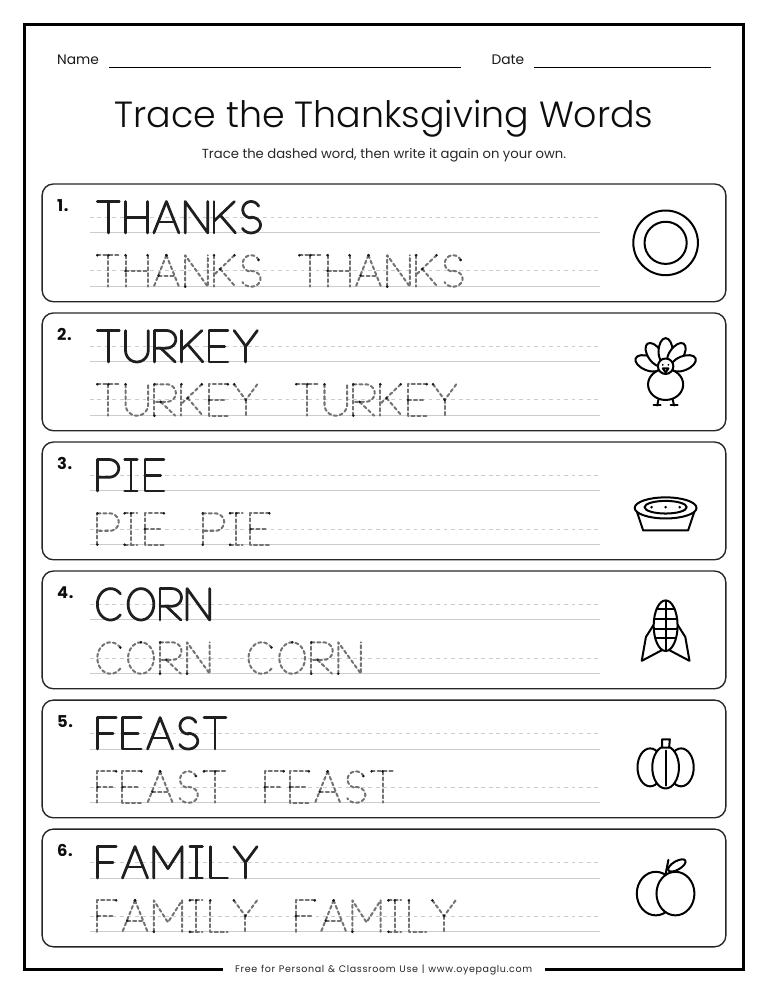
Six words (THANKS, TURKEY, PIE, CORN, FEAST, FAMILY) with a solid model, two dashed copies and room to write the word again.
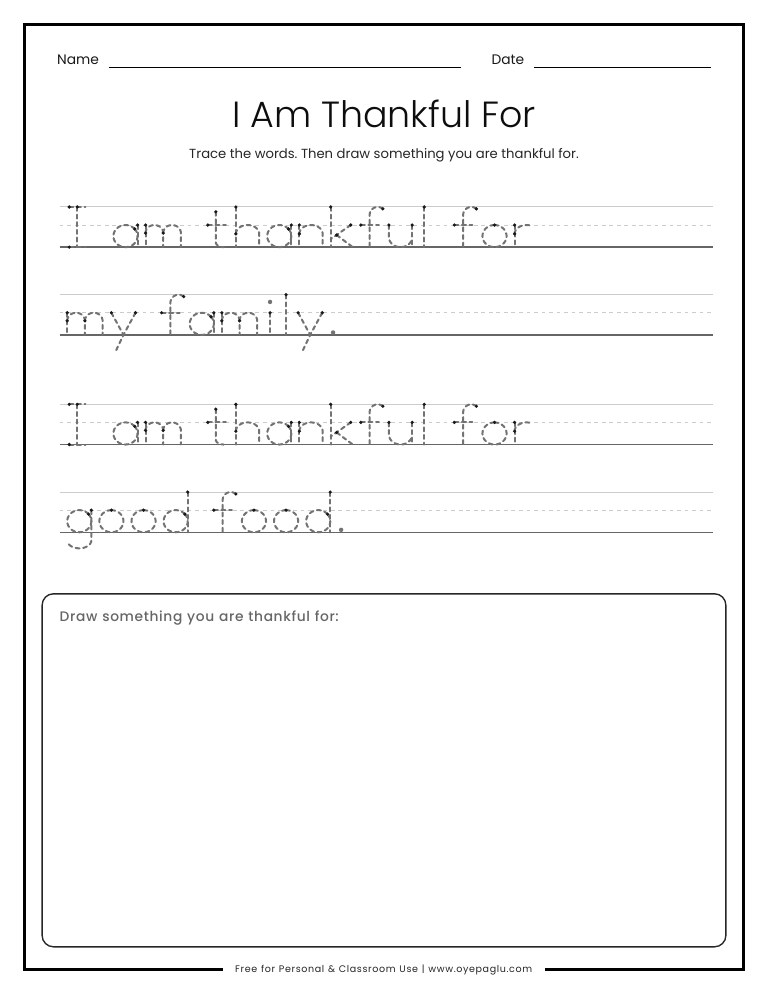
Two short sentences to trace, then a big box to draw something your child is thankful for.
Why tracing before writing?
Writing a letter is really a chain of small strokes, and each stroke is one of the movements above. A child who can already do a smooth wave or a steady circle finds “s” and “o” much less frustrating. That’s why these pages go from easy to hard instead of jumping straight to letters.
Which page should we start with?
- Age 3: Straight Lines, then Zigzag and Wavy Lines. Use a chunky crayon.
- Age 4: Pre-Writing Patterns, Shapes and Trace the Pictures.
- Age 5 to 6: Trace the Words and I Am Thankful For.
Ways to use them on Thanksgiving week
- Keep a few pages in a folder for kids’ table at the family dinner.
- Use the turkey page as a quiet-time activity while the adults cook.
- Read the “I Am Thankful For” page together afterwards and hang it on the fridge.
Frequently asked questions
What age are these for?
Roughly 3 to 6. The line and pattern pages suit 3 and 4 year olds. The word and sentence pages are for kindergarteners.
Do I need to print in colour?
No. Everything is black and grey, so a normal black and white printer works. The pictures are made to be coloured in by hand.
Which size should I download?
US Letter if you’re in the US or Canada, A4 almost everywhere else. Print at 100% / actual size, not “fit to page”.
Are they free?
Yes, for home and classroom use. Please don’t sell or re-host the PDFs.